
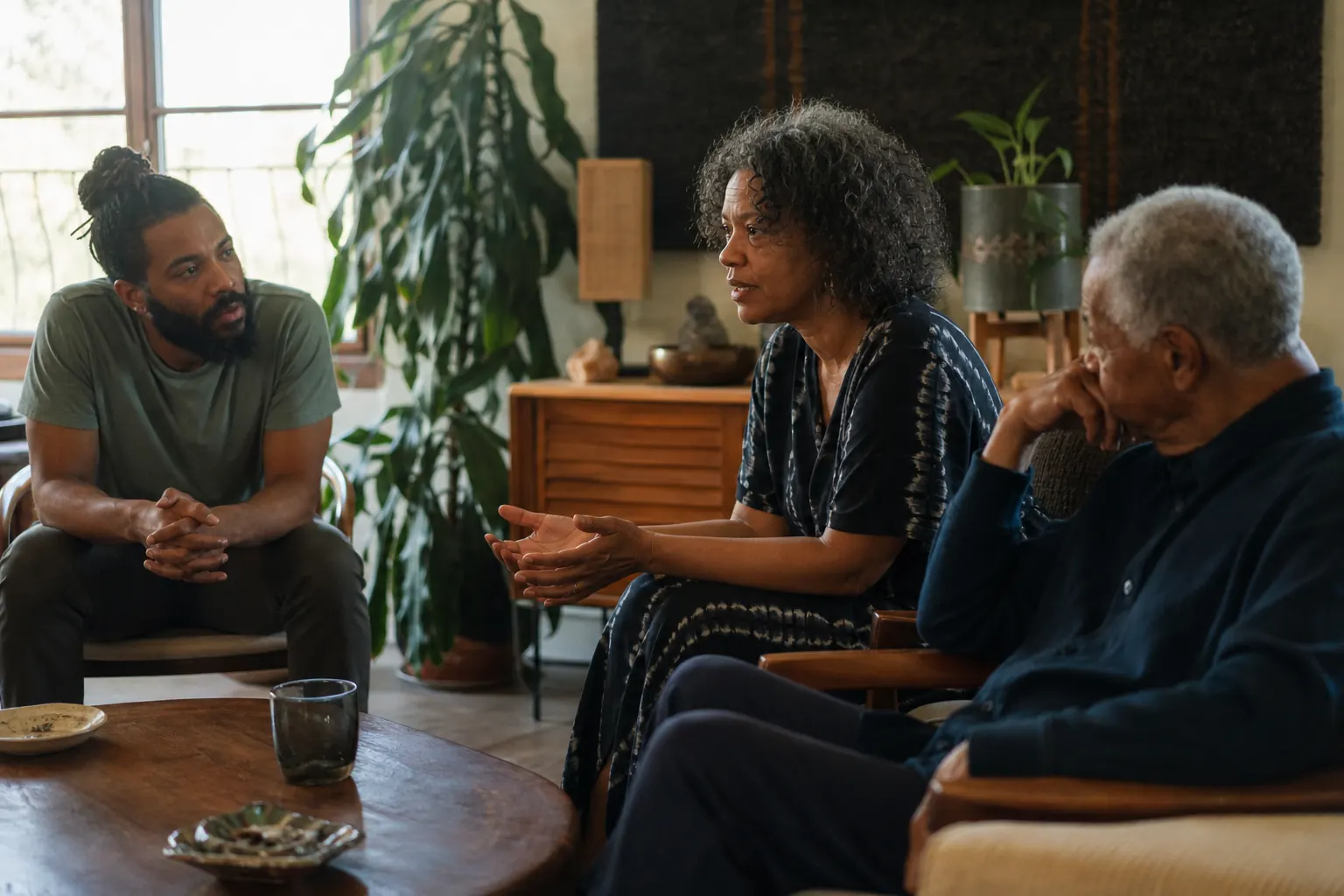


What family therapy is
Family therapy is therapy for a relationship, not for one person. In my practice it means sessions with two or more adult family members in the room together: a mother and her grown son, three siblings, a father and the daughter who stopped calling, a couple and the in-law everyone tiptoes around. The relationship between you is what we work on.
Families rarely come in because of one bad day. They come in because the same thing keeps happening. Every holiday ends with someone leaving early. Every phone call about Dad’s care turns into an argument about who does more. One comment about your weight or your job or your partner, and suddenly you’re fourteen again. Nobody plans it, and everyone can see it coming.
That predictability is useful. It means there’s a pattern, and a pattern can be understood and changed. Family therapy gives you a place to slow it down with someone who isn’t part of the family system and isn’t on anyone’s side.
Signs your family might benefit
You don’t need a crisis to start. These are some of the most common reasons adult families reach out:
- The same argument comes back every time you’re together, often about something small.
- Old roles still run the show: the responsible one, the peacemaker, the one who gets blamed.
- Someone has pulled away, and nobody knows how to talk about it.
- A parent is aging or ill, and caregiving has stirred up old resentments between siblings.
- A death, divorce, remarriage or inheritance has shifted the family and nobody has found their footing.
- Boundaries get set, then crossed, then fought about.
- You love each other and still dread seeing each other.
If any of that sounds familiar, it’s a good reason to start, before the distance gets harder to close.
Who comes to family therapy
Family looks different for everyone. I work with adult children and their parents, adult siblings, stepfamilies and blended families, in-laws, and chosen family: the friends and partners who became family when your family of origin couldn’t be. LGBTQIA+ families are welcome here, along with families where someone is in an open or polyamorous relationship.
Everyone in the room is 18 or older. I don’t see children or teenagers. If your family includes kids or teens and you want them in therapy, I’d suggest a child or adolescent family therapist, who is trained for that work. I can still support you as the adult parent in individual sessions while that happens.
Family relationships I work with most
Each of these has its own page with more detail.
Mothers and adult daughters
Close and still stuck: criticism that stings more than it should, old parent and child roles, boundaries that turn into fights. Read more about therapy for parents and adult children.
Family estrangement
For family members who have stopped speaking, or speak without saying anything real, and want to see whether repair is possible. See family estrangement therapy.
Adult siblings
Old rivalries, caring for a parent, splitting an estate, or simply growing apart. Sibling therapy helps you meet each other as the adults you are now.
Parents and adult children
When a grown child and a parent can’t seem to relate as two adults, or a parent feels shut out and doesn’t know why. Read about parent and adult child therapy.
Some important relationships aren’t family at all. Bandmates, business partners and creative partners can get caught in patterns that look a lot like family ones, and I see them through relationship therapy. If your family is working through a partner’s open or polyamorous relationship, non-monogamy and polyamory therapy may also help.
How I work with families
Most families already know what they fight about. What’s harder to see is why the same thing keeps happening even when everyone means well. When a family member says something that lands on an old hurt, your nervous system reacts before you have time to think. You go quiet, or sharp, or you leave. The other person reacts to that. Within a minute, everyone is doing what they always do.
So I work with what happens in the room, while it’s happening. We slow it down, name what each person is feeling and protecting, and try something different together. I draw on several approaches and use what fits your family:
- PACT, developed by Stan Tatkin for couples, offers a clear way to understand how stress and old attachment patterns play out between people in real time. I use those ideas with families.
- Imago, from Harville Hendrix and Helen LaKelly Hunt, uses structured dialogue so each person actually hears the other before responding.
- Attachment-based work looks at how early relationships shape the way we reach for, or pull away from, the people closest to us.
- Interpersonal neurobiology explains how relationships shape the brain and nervous system, and how new experiences together can change old reactions.
- Gottman Method ideas from John and Julie Gottman give practical tools, like starting a hard conversation gently and repairing after it goes wrong.
- Emotionally Focused Therapy (EFT), developed by Sue Johnson, helps people see the cycle they’re caught in and the needs underneath it.
I also bring in ideas from family systems theory, especially the work of Murray Bowen. Bowen saw the family as one emotional unit, where a change in one person affects everyone. His ideas help us notice patterns passed down through generations, the way two people in tension pull in a third (he called these triangles), and how to stay yourself while staying connected. If you’re curious how this compares with other approaches, I’ve written about types of family therapy models.
Nobody is the problem. The pattern is.
How sessions work with several people
Having more than two people in the room changes things, so I keep the structure clear. Sometimes I meet with each person individually before we start joint sessions. That gives everyone a chance to say what they’re hoping for, and what they’re worried about, without an audience.
In joint sessions, everyone gets a turn to be heard, and I slow things down when a conversation starts heading somewhere familiar. I won’t let one person do all the talking, and I won’t decide who’s right. The goal is for each of you to leave feeling understood, even when you still disagree.
I never contact a family member without your consent. If you’re the one reaching out, you decide who is invited and when.
What to expect
It starts with a free 20-minute video consultation. One person can book it. You tell me a little about what’s going on, ask anything you like, and we see whether I’m a good fit. There’s no pressure to book.
A first joint session can be 90 minutes, which gives everyone time to speak without rushing. We’ll talk about what brought you in, what each of you wants to change, and start to map the pattern you keep landing in. Between sessions, you’ll usually have something small to try, like a new way to end a phone call before it turns. For ideas you can use at home, see these family therapy activities.
We usually meet weekly or every other week at first, then less often as things ease. How long it takes depends on your family and what you’re working on.
How much family therapy costs
- 60-minute session: $250
- 90-minute session: $325
- 20-minute video consultation: free
Fees are per session, not per person, however many of you attend. I don’t bill insurance directly. For these sessions I can provide a superbill you can submit to your insurer for possible out-of-network reimbursement. It’s worth calling your plan first to ask what they cover for family therapy. I don’t offer intensives for family work.
In person in Highland Park, or online in California
My office is at 5317 North Figueroa Street in Highland Park. Families come from across Northeast LA and nearby, including Eagle Rock, Mount Washington, Glassell Park, Silver Lake, Echo Park, Pasadena and Glendale.
I also see families online anywhere in California. Online sessions can make it easier to get busy adults on the same schedule, and some families mix in-person and online sessions. When you’re ready, book a free consultation.