
When talking to each other keeps going wrong
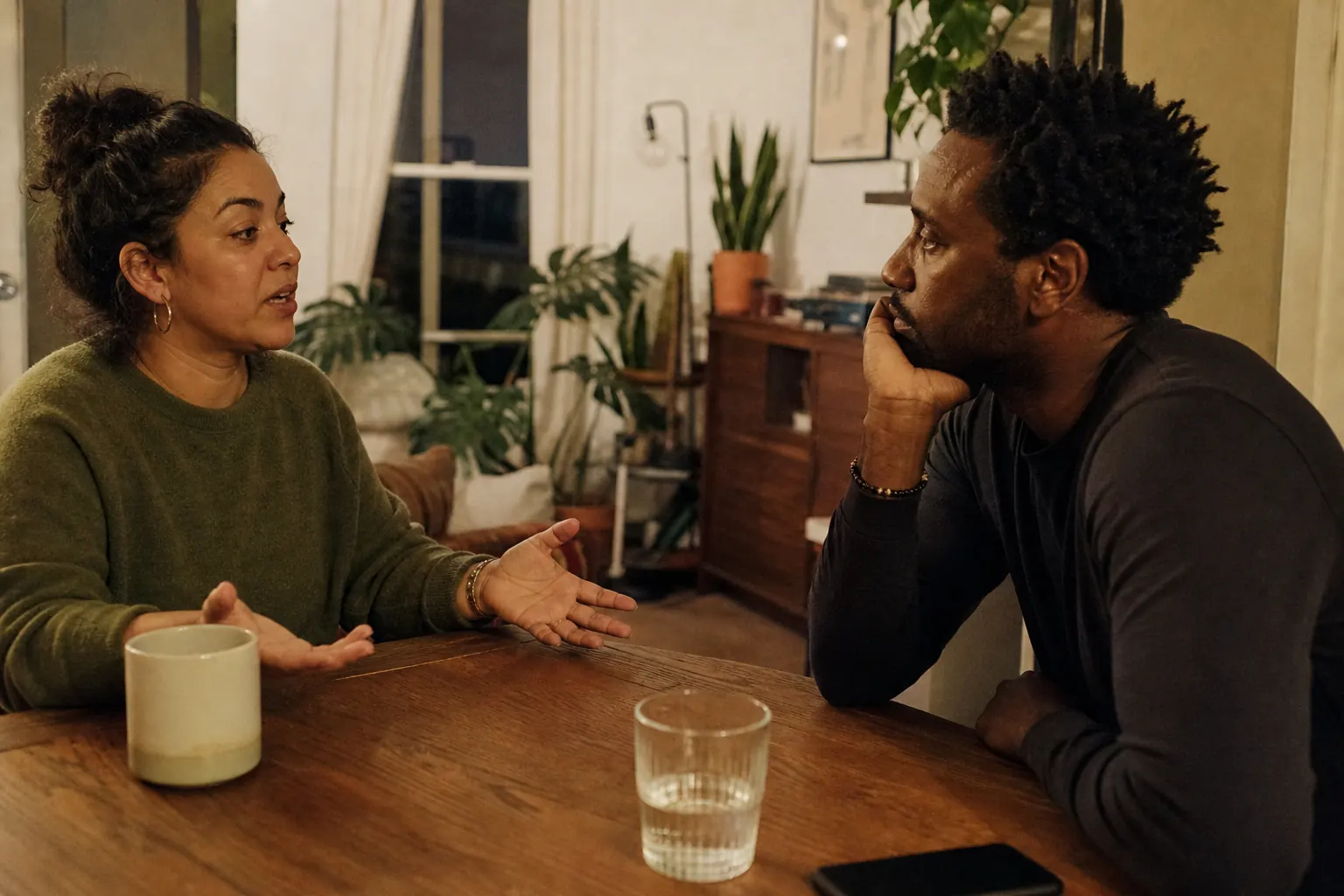
Most couples who ask me for help with communication can already talk. They talk all day about the kids, the rent and the groceries. What breaks down is the conversation that matters. One of you raises something small, the other hears criticism, and ten minutes later you’re both somewhere neither of you meant to go.
It often starts with the fight about the dishes that’s never about the dishes. Underneath it is a different question: do you notice what I carry, do you care how I feel, can I count on you. When that question never gets said out loud, it keeps coming back in a new outfit. Couples communication therapy is where we slow that moment down and find out what each of you is actually trying to say.
Signs communication therapy could help
You don’t need to be in crisis to start. These are some of the most common things couples tell me in a first call:
- We have the same argument over and over, and it never gets resolved.
- Small comments turn into big fights, fast.
- One of us pushes to talk and the other goes quiet or leaves the room.
- I stopped bringing things up because it isn’t worth the fight.
- We don’t know how to make up after a bad argument, so we just wait it out.
- We still care about each other, and I still feel lonely in this relationship.
If a few of those sound familiar, the problem usually isn’t that you lack the right words. It’s the pattern you fall into when the conversation gets hard.
Why “just communicate better” often doesn’t work
A lot of couples I see have already tried. They read the books, learned “I statements,” maybe did a round of counseling. They left understanding each other better. Then the same fight happened at home on a Tuesday night.
That isn’t a failure of effort. When a conversation starts to feel threatening, your nervous system (the body’s built-in alarm system) reacts faster than any script you learned. Your heart rate climbs, your hearing narrows, and you protect yourself the way you always have. John Gottman calls this being “flooded.” Once you’re flooded, good communication skills are very hard to reach.
So my work isn’t mainly about teaching phrases. It’s about catching the pattern while it’s happening, understanding why each of you reacts the way you do, and practicing something different in the room until it starts to feel possible at home.
Nobody is the problem. The pattern is.
The patterns I look for
A few patterns show up again and again.
Criticism and defensiveness
A complaint about one thing (“you didn’t call”) becomes a statement about who someone is (“you never think about me”). The other person defends, explains or counterattacks. Both of you end up feeling unheard.
Pursue and withdraw
One partner moves toward the problem, wanting to talk it through now. The other moves away, needing space to calm down. The more one pursues, the more the other withdraws, and the more the other withdraws, the harder the first one pursues. Neither of you is wrong. You’re caught in a loop.
Shutting down
Some people go silent in a fight because they’re overwhelmed, not because they don’t care. From the outside it can look like coldness. From the inside it often feels like the only way to keep from saying something that makes it worse.
Contempt
Eye-rolling, sarcasm, mocking. Contempt usually grows from resentment that has never been heard. It’s one of the hardest patterns on a relationship, and it’s also something we can work on directly.
John and Julie Gottman call criticism, defensiveness, contempt and stonewalling (shutting down) the “Four Horsemen,” and their work offers a clear alternative to each one.
How I work with couples on communication
I draw on several research-based approaches and use what fits the two of you:
- PACT, developed by Stan Tatkin, looks at how your stress responses and attachment histories play out between you in real time. A lot of this work happens in the room, as it happens.
- Imago, from Harville Hendrix and Helen LaKelly Hunt, uses a structured dialogue: one person speaks, the other mirrors back what they heard, and only then responds.
- Attachment-based work looks at how early relationships shaped the way you reach for, or pull away from, the person closest to you.
- Interpersonal neurobiology explains how relationships shape the brain and nervous system, and how new experiences together can change old reactions.
- Gottman Method, from John and Julie Gottman, gives practical tools such as starting a hard conversation gently and repairing after a fight goes wrong.
- Emotionally Focused Therapy (EFT), developed by Sue Johnson, helps couples see the cycle they’re caught in and the needs underneath it.
I’m active in sessions. If a conversation starts to escalate, I’ll slow it down. I won’t take sides, and I won’t let one of you do all the talking.
What you practice, and take home
Insight is the start, not the goal. Most sessions end with something small and specific to try before the next one. Depending on what’s going on, that might be:
- A gentler start. Raising a concern about one situation, with how you feel and what you need, instead of a list of everything that’s been wrong.
- Noticing when you’re flooded. Agreeing on a signal to pause, and on coming back to the conversation once you’ve both calmed down.
- Validation. Letting your partner know their feelings make sense to you, even when you see things differently. I’ve written more about how to validate someone’s feelings.
- Repair. Small moves that turn a fight around: a touch, a joke, “I’m sorry, that came out wrong.” Every couple fights. Couples who do well tend to get better at repair.
- Saying the thing underneath. “I’m scared you’re pulling away” lands very differently from “you’re always on your phone.”
For more on why this matters, read the power of communication in a relationship. If your arguments escalate quickly or feel out of control, therapy for high-conflict couples goes deeper on that.
What to expect
It starts with a free 20-minute video call. You tell me a little about what keeps happening, ask anything you want, and we see whether I’m the right fit. There’s no pressure to book.
In the first session together, I’ll want to hear from each of you: what brought you in, what a typical bad conversation looks like, and what you’d like to be different. We’ll start to map the loop you land in. You won’t be asked to defend yourself.
We usually meet weekly at first. As conversations start going differently at home, sessions space out to every other week and then monthly. Some couples add a Couples Intensive to work on one stuck conversation in a longer block of time.
How much does it cost?
- 60-minute session: $250
- 90-minute session: $325
- Couples Intensives: $600 for 3 hours, $1,100 for 6 hours
I don’t bill insurance directly. For regular sessions, I can give you a superbill to submit for possible out-of-network reimbursement. Superbills aren’t available for intensives or retreats. It’s worth asking your plan what they cover for couples therapy before you start.
In person in Highland Park, or online across California
My office is at 5317 North Figueroa Street in Highland Park. Couples come from Eagle Rock, Mount Washington, Glassell Park, Silver Lake, Echo Park, Pasadena, Glendale and nearby. I also see couples online anywhere in California, which helps with long workdays, shoots and travel schedules.
Communication work isn’t only for romantic partners. If the same loop shows up with a sibling, a parent or a creative partner, I work with those relationships too. When you’re ready, book a free consultation.