


What is discernment counseling?
Discernment counseling is a short, structured process for couples where one partner is thinking about ending the relationship and the other wants to keep trying. It was developed by William Doherty, a family therapist and professor at the University of Minnesota, for exactly the moment when regular couples therapy tends to stall.
The goal is not to fix the relationship. Not yet. The goal is clarity: helping both of you decide, with confidence and with a better understanding of what went wrong, which direction to take next. I use the discernment counseling model in my practice because so many couples arrive at my door split on that question, and pretending otherwise wastes their time and money.
If you’ve ever sat in a couples session where one of you was working hard and the other was quietly counting the minutes, you already know why this exists.
Who discernment counseling is for
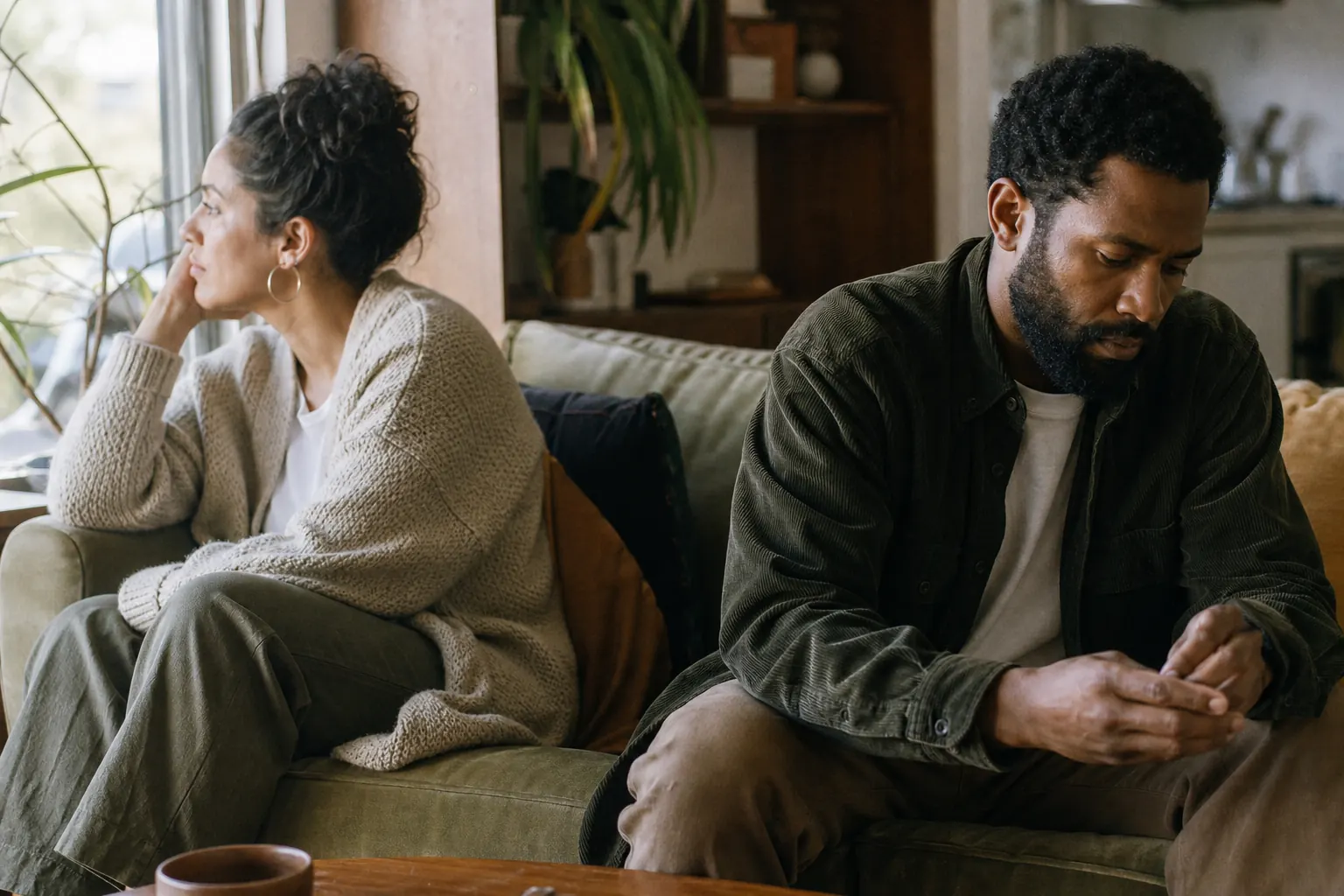
Doherty calls these “mixed-agenda” couples. One partner is leaning out: unsure, worn down, maybe already picturing life apart. The other is leaning in: hurt, often scared, and wanting to work on things. Both positions make sense. Neither person is the villain.
It may fit if:
- One of you has said the words “I don’t know if I want this anymore,” and you’ve been living in that sentence ever since.
- You’ve tried couples therapy before and it went nowhere because one of you wasn’t really in it.
- You keep cycling between trying and wanting to leave.
- There has been an affair or a long run of hurt, and the leaning-out partner can’t tell if they want to repair it.
- Children, money or a shared home make the decision heavier, and you don’t want to make it in a bad week.
It isn’t the right fit if one partner has fully decided to leave and wants help ending things. In that case conscious uncoupling is usually a better place to start. It also isn’t right where there is violence or fear of a partner, where separate, individual support comes first. If anyone is in crisis, call or text 988.
The three paths
Discernment counseling ends with a decision between three paths. You choose one together, or at least with full knowledge of where each of you stands.
Path one: stay as you are
Keep the relationship as it is for now, without separating and without starting couples therapy. Some couples choose this to buy time. It’s a legitimate choice, made consciously.
Path two: move toward separation or divorce
Decide that ending the relationship is the right direction, and do it with a clearer understanding of how you got here. That understanding matters, especially if you’ll be co-parenting.
Path three: a six-month, all-in effort at couples therapy
Take divorce off the table for six months and commit fully to couples therapy, with each of you working on your own part. At the end of that time you reassess with real information instead of fear.
Notice there’s no “fix it in discernment” option. The work here is deciding. The repair, if you choose it, comes after.
How discernment counseling differs from couples therapy
Couples therapy assumes you’re both there to improve the relationship. Discernment counseling doesn’t assume that. A few things follow from it:
- It’s short. Doherty describes it as one to five sessions. You decide at the end of each session whether to come back for another.
- Most of the time is spent one on one. I meet with each of you separately for much of the session, with short joint check-ins. The leaning-out partner can be honest about ambivalence without wounding the other in real time. The leaning-in partner can be heard without having to perform calm.
- Each person looks at their own part. Not “what my partner does wrong,” but “what I contribute to the pattern, and what I’d have to change.” That’s often the first time either person has said it out loud.
- No homework, no skills training. We’re not practicing communication tools yet. We’re getting clear.
If you’re both clearly committed to working on things, couples therapy is the better fit, and I’ll tell you so on the consultation call.
What to expect in sessions
Following Doherty’s model, the first session is two hours and follow-up sessions are 90 minutes. That’s longer than a typical therapy hour because the separate conversations take time.
We begin together, so I can hear how each of you sees the relationship and what brought you in. Then I talk with each of you alone. With the leaning-out partner, I’m curious about the ambivalence: what’s driving it, what’s been tried, what you’d need to see. With the leaning-in partner, I help you show up as the best version of yourself in this moment, which usually means less pleading and more honest ownership. We close with a short joint conversation about what each of you is taking away, and whether you want another session.
Nobody is pressured to stay or to go. My job is to protect the process so the decision you make is yours, not the product of guilt, panic or one bad Saturday.
How I work
I use the discernment counseling model as Doherty designed it, and I bring 13+ years of couples work to it. As a college instructor and clinical supervisor I also teach this kind of work, which keeps me honest about doing it carefully.
Underneath the structure, I draw on attachment-based work and interpersonal neurobiology. In plain terms: when a relationship feels threatened, both nervous systems go on high alert. The leaning-in partner often pursues harder; the leaning-out partner often shuts down further. Seeing that cycle clearly, without blame, is often what lets both of you think straight for the first time in months.
I also know this place from the inside. I’ve lived my own relationship patterns and done my own therapy, so I’m not shocked by ambivalence, affairs or the things people are afraid to say.
After discernment: what comes next
If you choose path three, we can move straight into couples therapy, and some couples start with a Couples Intensive to build momentum. If trust was broken, infidelity recovery work often becomes the center of it.
If you choose path two, conscious uncoupling can help you separate with less damage, and co-parenting counseling can help you build a working partnership around your kids.
How much does discernment counseling cost?
- First session (2 hours): $450
- Follow-up sessions (90 minutes): $325
- Free 20-minute video consultation
Because the process is short, the total cost is usually far less than a long course of couples therapy that never gets traction. I don’t bill insurance directly. I can give you a superbill for possible out-of-network reimbursement; call your plan first to ask what they cover.
In person in Highland Park, or online across California
My office is at 5317 North Figueroa Street in Highland Park, close to Eagle Rock, Mount Washington, Glassell Park, Silver Lake, Echo Park, Pasadena and Glendale. I also offer discernment counseling online anywhere in California, which helps if you’re already living apart or can’t be in the same room comfortably yet.
The first step is a free 20-minute video call. You can tell me where each of you stands, and we’ll figure out together whether discernment counseling is the right starting point. Book a free consultation.