
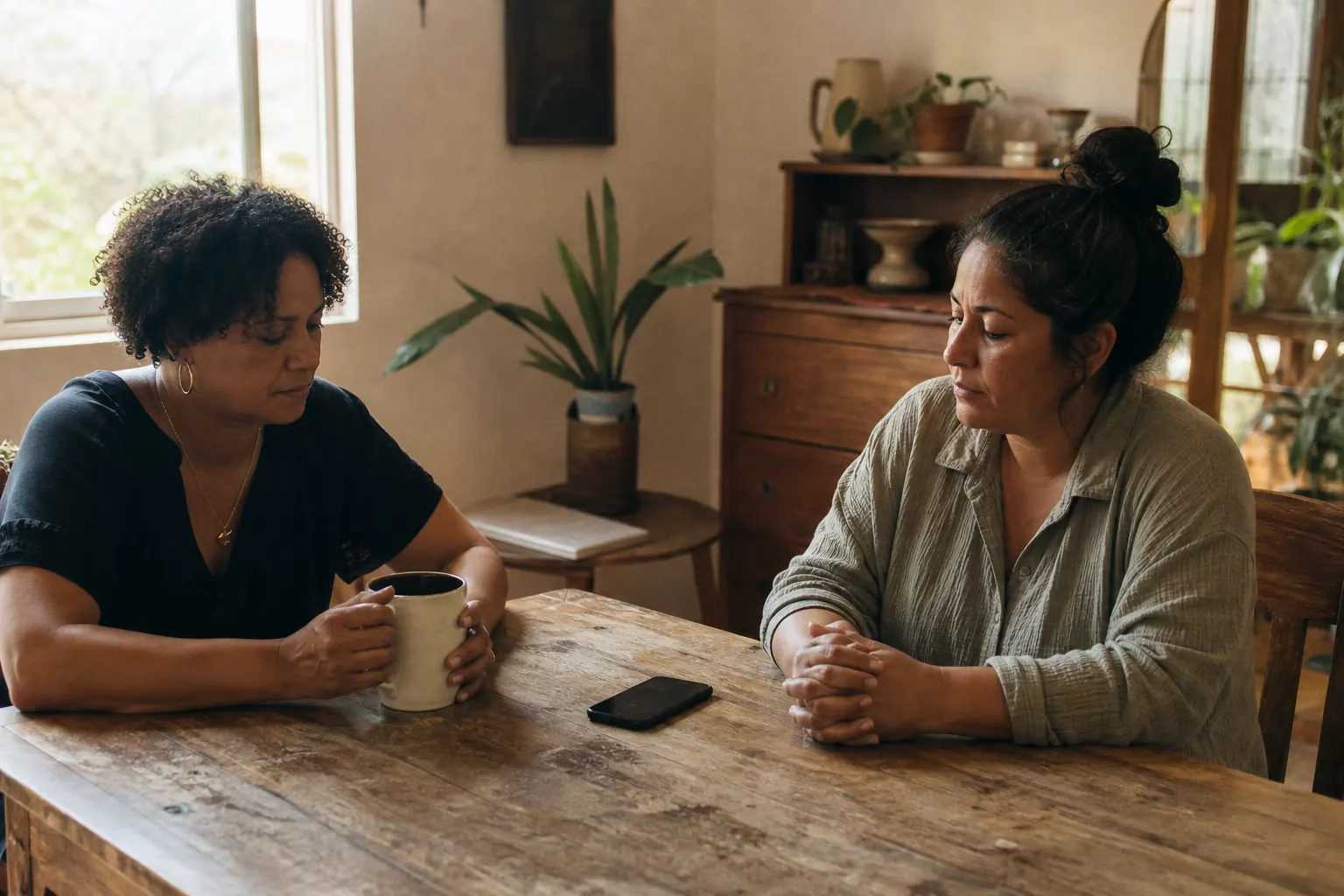


After the discovery
Maybe you found the messages. Maybe your partner told you, or you told them. Either way, the ground has moved. You may be replaying details at 3 a.m., checking a phone you never used to look at, or swinging between rage and wanting to be held by the person who hurt you. If you’re the one who had the affair, you may be drowning in shame, trying to fix everything at once, and getting it wrong every time you open your mouth.
All of that is normal after a betrayal. It doesn’t mean the relationship is over, and it doesn’t mean it will survive. It means you’re both in shock, and you need a steady place to slow down before anyone makes a permanent decision.
Infidelity counseling is couples therapy for exactly this: helping two people understand what happened, repair what can be repaired, and decide, honestly, what comes next.
Betrayal isn’t only a physical affair
Couples come to me after many kinds of breach. A sexual affair, an emotional affair that crossed a line, secret dating apps, a hidden online relationship, debt kept quiet for years, or a broken agreement in an open relationship. What they share is that one person believed something about the relationship that wasn’t true, and finding out has shaken their sense of what’s real.
That shock is why some people describe it as betrayal trauma. For the hurt partner, the body can react to reminders as if the danger is still happening: a racing heart when a phone buzzes, trouble sleeping, sudden waves of panic. That isn’t overreacting. It’s a nervous system trying to protect you. If the breach happened inside a non-monogamous structure, non-monogamy and polyamory therapy covers how I work with agreements and trust in open relationships.
Two people, two kinds of pain
If you were betrayed
You may feel humiliated, foolish for not seeing it, or terrified of being lied to again. You may need to ask the same questions many times. Your self-esteem may have taken a hit you didn’t expect. Your pain needs room in the work, and you won’t be rushed toward forgiveness.
If you had the affair
You may feel guilt, grief, defensiveness, or relief that the secret is out. You might also be grieving the affair itself, which can feel impossible to admit. Your experience matters too. Real repair needs you to take full responsibility, and it also needs you to understand yourself well enough that this doesn’t happen again. Being understood is not the same as being excused, and I’ll hold both.
Nobody is the problem. The pattern is. And the person who broke trust is still responsible for repairing it.
The phases of affair recovery
Recovery isn’t a straight line, but it tends to move through three broad phases. John and Julie Gottman describe a similar arc as atone, attune and attach.
1. Crisis
The early weeks are about stabilizing. We work on stopping the bleeding: ending contact with the affair partner, agreeing on how hard conversations will happen so they don’t take over every evening, and giving the hurt partner honest answers without retraumatizing either of you. The partner who had the affair learns how to stay present with their partner’s pain instead of defending or disappearing.
2. Understanding
Once things are steadier, we look at how this happened. Not to blame the hurt partner, and not to explain the affair away. We look at what was going on in the relationship and in the person who strayed: distance that grew, needs that went unspoken, old patterns of avoiding conflict or seeking escape. This is often where both of you start to see each other more clearly.
3. Rebuilding
If you both choose to stay, we build something new rather than going back to what existed before. That means new agreements, rebuilding trust through consistent actions over time, and, when you’re ready, finding your way back to physical closeness. Intimacy therapy goes deeper on that part.
Should we stay together?
You don’t have to know yet. Many couples start this work with one partner sure they want to rebuild and the other unsure whether they can. Some couples find that recovery brings them closer than they were. Others realize, with a clearer head, that it’s time to part. I can’t promise which way it will go, and I won’t push you toward either one.
If one of you is leaning out and the other is leaning in, regular couples therapy can stall. Discernment counseling, a short, structured process developed by William Doherty, can come first. It helps you each get clear on whether to work on the relationship, separate, or take more time, before committing to full recovery work. If you decide to separate, conscious uncoupling helps you do it with less damage.
Recovery work goes best once the outside relationship has ended. If it hasn’t, that’s important to talk about honestly in our first conversation.
How I work with infidelity
I draw on several research-based approaches:
- Gottman Method, developed by John and Julie Gottman, for structure through the phases of recovery and practical tools for repair.
- Emotionally Focused Therapy (EFT), developed by Sue Johnson, which treats an affair as an attachment injury: a wound to the bond itself. It helps you see the cycle you fall into when the betrayal comes up, and reach for each other instead.
- PACT, developed by Stan Tatkin, and interpersonal neurobiology, to work with the stress responses that flare in both of you, in the room, as they happen.
- Attachment-based work, to understand how earlier experiences shape the way each of you reacts to betrayal and to repair.
What to expect
It starts with a free 20-minute video call, where you can tell me what happened in broad strokes and ask how I work. No pressure to book.
In the first sessions, I’ll hear from both of you about the relationship, the discovery and what you each need right now. I don’t keep secrets for one partner from the other, and I’ll explain early how we handle questions about details. We usually meet weekly during the crisis phase. Some couples add a Couples Intensive, which gives you three or six hours to work through the hardest conversations without stopping at the hour mark.
The hurt partner usually has a lot of questions, and some will come up again and again. That’s part of how trust is rebuilt. I’ll help you both tell the difference between questions that build understanding, like why and how it happened, and questions about graphic details that tend to replay as images later. The partner who had the affair learns to answer honestly and patiently, even the fifth time.
If you’re having thoughts of harming yourself, please call or text 988, the Suicide and Crisis Lifeline, any time.
How much does it cost?
- 60-minute session: $250
- 90-minute session: $325
- Couples Intensives: $600 for 3 hours, $1,100 for 6 hours
I don’t bill insurance directly. For regular sessions, I can give you a superbill for possible out-of-network reimbursement. Superbills aren’t available for intensives or retreats.
In person in Highland Park, or online across California
My office is at 5317 North Figueroa Street in Highland Park, close to Eagle Rock, Mount Washington, Glassell Park, Silver Lake, Echo Park, Pasadena and Glendale. I also see couples online anywhere in California, which can help when you’re living apart for a while. When you’re ready, book a free consultation.