
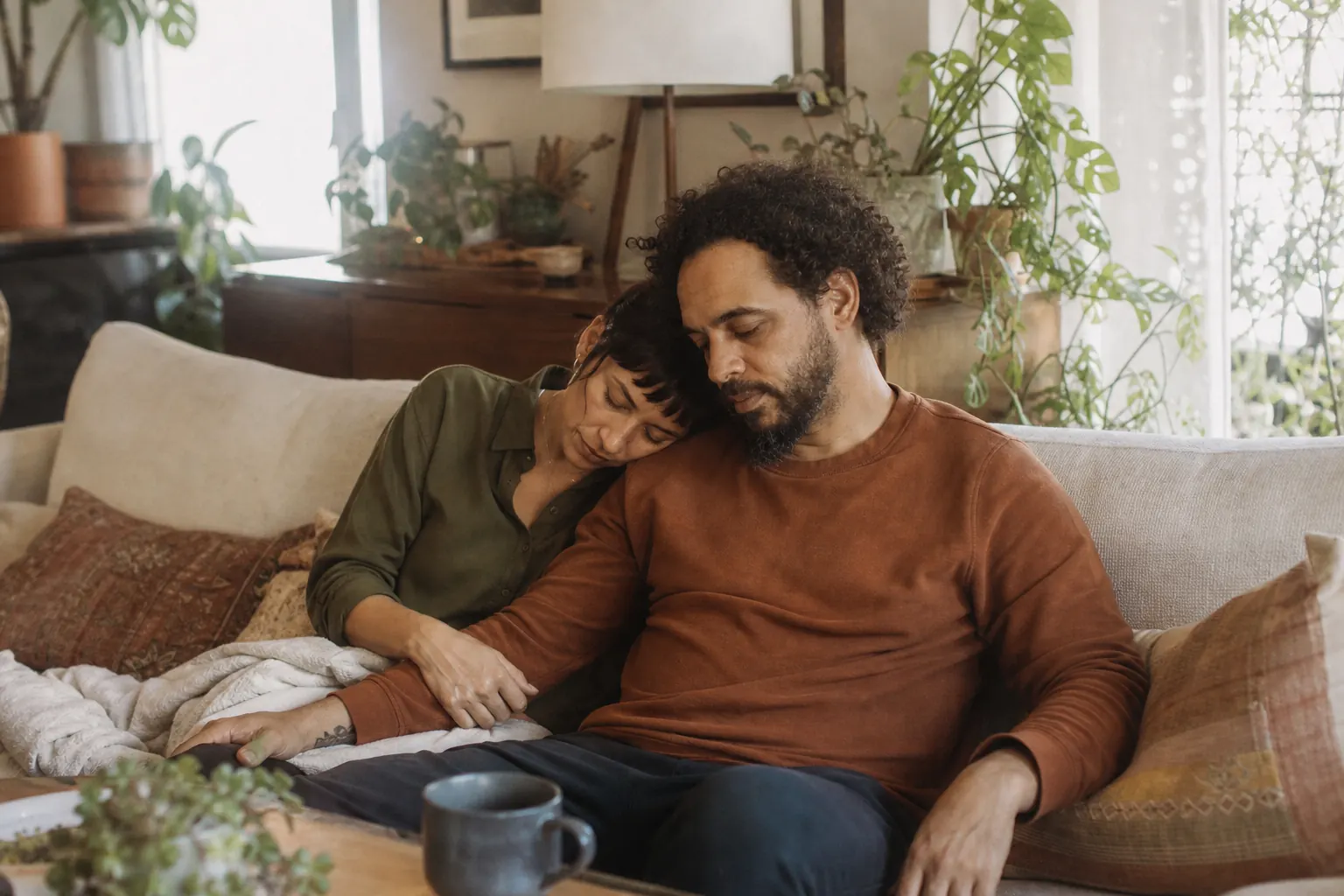


When closeness has gone quiet
Most couples who come to me about intimacy aren’t short on love. They’re short on contact. Somewhere along the way, sex became a topic you both step around. One of you has stopped reaching because the last few times felt like rejection. The other has started bracing every time a hug lasts a little too long, because it might be a question.
Neither of you is doing anything wrong. You’ve each found a way to protect yourself, and those two ways of protecting yourselves have locked together. That’s the pattern I want to help you see.
Intimacy therapy for couples is couples therapy that puts closeness at the center: physical, sexual and emotional. We talk about sex directly, without blame, and we look at what’s happening around it, because what happens in the bedroom usually starts long before anyone gets there.
What intimacy therapy can help with
Different levels of desire
Desire differences are one of the most common reasons couples come in. The partner who wants more often feels unwanted. The partner who wants less often feels like a disappointment, or like sex has become a chore they keep failing. Both of those hurt, and both make sense. We work on understanding what each of you needs to feel open to closeness, which is rarely the same thing for two people.
The dry spell that kept going
A new baby, a hard year at work, a move, grief. Sex slowed down for a good reason, and then it never really came back. Now the gap feels so big that starting again seems awkward or loaded. We look at how to come back toward each other in small, low-pressure steps instead of one high-stakes night.
Talking about sex without it turning into a fight
For a lot of couples, the conversation about sex goes badly every time, so they stop having it. One person hears criticism, the other hears dismissal. In session, I slow that conversation down so each of you can say what’s true and actually be heard.
Roommate mode
You still run a household well together. You might even laugh together. But affection, flirting and play have faded, and you miss feeling wanted. Rebuilding everyday closeness, the touch that isn’t a request for sex, is often where the work starts.
Closeness after a betrayal or a big change
After an affair, intimacy can feel risky for both of you. After illness, surgery, a body change or a shift in gender identity or relationship structure, old ways of being close may not fit anymore. If trust is the main wound, infidelity and betrayal recovery may be the better place to begin.
When one of you feels like “the problem”
Often one partner arrives feeling like the one who’s broken: the one with low desire, the one who wants too much, the one who can’t relax. I don’t see it that way. Desire lives between two people, shaped by stress, resentment, safety and how each of you has been touched and talked to over the years. When we stop looking for the faulty partner and start looking at the pattern you share, both of you can usually breathe out a little.
Is this sex therapy?
I want to be clear about this, because it matters when you’re choosing who to work with. I’m a Licensed Clinical Social Worker (LCSW) and a couples therapist. I’m not a certified sex therapist, and I don’t hold AASECT certification. AASECT, the American Association of Sexuality Educators, Counselors and Therapists, is the body that certifies sex therapists in the US.
What I do is couples therapy focused on intimacy and sex: desire differences, reconnection, the emotional and relational side of a sexual relationship, and the conversations that have felt impossible at home. That’s what most couples I see are looking for.
Some concerns call for more specialized care. Pain during sex, erection or arousal changes that have a physical cause, hormonal shifts, medication side effects, or long-standing sexual difficulties may need a physician, a pelvic floor physical therapist or a certified sex therapist. When that’s the case, I’ll say so, and you can see that person alongside our couples work. I don’t give medical advice, and I’d rather you get the right help than stay with me out of loyalty.
Sessions are talk therapy. Nobody undresses, and there’s no touch in the room. Any exercises happen at home, in private, at a pace you both agree to.
How I work with intimacy
Sex rarely improves because someone learned a new technique. It improves when both partners feel safe enough to want, to say no, and to try again. So I look at what’s happening in your nervous systems, meaning the body’s automatic sense of safety or threat, when closeness comes up.
I draw on several approaches and use what fits:
- Gottman Method, developed by John and Julie Gottman, for rebuilding friendship, fondness and the small daily moments of turning toward each other that make physical closeness possible.
- Emotionally Focused Therapy (EFT), developed by Sue Johnson, to help you see the cycle of pursuing and withdrawing around sex and the fears underneath it.
- PACT, developed by Stan Tatkin, which pays close attention to how stress and attachment show up in your bodies in real time.
- Attachment-based work and interpersonal neurobiology, which look at how early experiences shape what feels safe, wanted or risky in a close relationship now.
Nobody is the problem. The pattern is.
What to expect
It starts with a free 20-minute video call. You can tell me a bit about what’s going on and ask how I work. There’s no pressure to book.
In the first sessions, I’ll want to hear each of your views of the relationship as a whole, not only sex. We’ll talk about what closeness used to look like, what changed, and what each of you is afraid will happen if you try again. I’ll ask direct questions, in plain language, and I won’t be shocked by your answers.
From there, we work on two tracks: what happens between you in the room, and small things to try at home. That might be a new way to start the conversation, a way to say no that doesn’t feel like rejection, or touch with no expectation attached. We usually meet weekly to begin. Some couples add a Couples Intensive to give the topic real, unhurried time.
How much does it cost?
- 60-minute session: $250
- 90-minute session: $325
- Couples Intensives: $600 for 3 hours, $1,100 for 6 hours
I don’t bill insurance directly. For regular sessions, I provide a superbill you can submit for possible out-of-network reimbursement. Superbills aren’t available for intensives or retreats. It’s worth asking your plan what it covers for couples therapy before you start.
In person in Highland Park, or online across California
My office is at 5317 North Figueroa Street in Highland Park. Couples come from Eagle Rock, Mount Washington, Glassell Park, Silver Lake, Echo Park, Pasadena, Glendale and nearby. Some people find these conversations easier in an office that isn’t their bedroom or kitchen.
I also see couples online anywhere in California. For others, talking about sex from their own couch, in their own space, is what makes it possible at all.
A sex-positive, affirming practice
Being sex-positive means I don’t have a picture of what your sex life should look like. Some couples want more sex, some want different sex, some want less pressure and more affection. Kink, asexuality, open relationships, queer and trans bodies and relationships: all of it is welcome here, without explanation or apology. See also LGBTQ+ couples therapy and non-monogamy and polyamory therapy.
If you’d like to talk it through first, book a free consultation.