
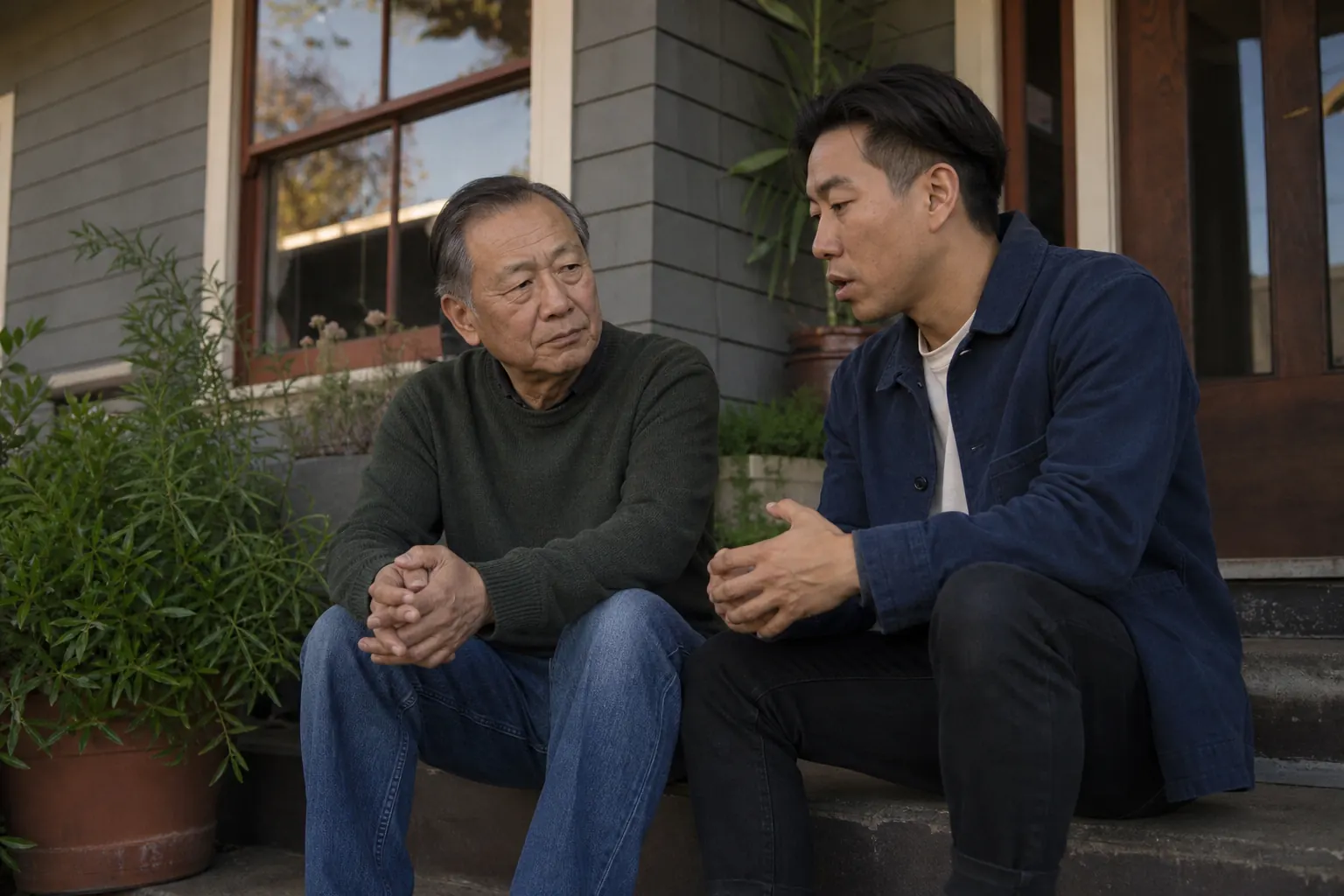


Therapy for parents and adult children
This is therapy for the relationship between a parent and a grown child. You come in together, a mother and her son, a mother and her daughter, a father and his daughter, a father and his son, sometimes both parents and more than one adult child, and the relationship between you is what we work on.
The hardest part of this relationship is that it has to change shape. For years one of you was in charge and the other was dependent. Then the child grows up, and you’re supposed to become two adults who know each other. Many families never quite make that shift. The parent still gives advice nobody asked for. The adult child still feels judged by a single raised eyebrow. A phone call about weekend plans turns into an argument about something that happened twenty years ago.
Everyone in the room is 18 or older. I don’t see children or teenagers. If you’re the parent of a teen, I’d suggest an adolescent or family specialist for them, and I can support you as the adult parent in individual sessions.
Signs it might help
- You love each other and still can’t get through a visit without a fight.
- You feel treated like a child, or treated like a disappointment.
- Your adult child has pulled back and you don’t know why.
- Old hurts from childhood keep surfacing, and the conversation always stalls.
- A divorce, a new partner, a move or a parent’s illness has changed the relationship.
- Your son’s or daughter’s partner has become the thing you argue about.
- Your parent is aging, and you’re starting to care for the person who used to care for you.
Parent and adult child relationships I work with
Every pairing has its own history and its own sore spots. People often search for help with one specific relationship, so here’s how each tends to look in my office.
Mother and son therapy
Mothers and sons can be close in ways that get complicated as the son grows up. Sometimes a mother leaned on her son emotionally after a divorce or a hard marriage, and he became her confidant before he was ready. As an adult he may feel guilty for wanting space, and she may feel abandoned when he takes it. A son’s partner can land right in the middle of this. In sessions we look at how to stay close without one of you carrying the other’s feelings, and how a mother can feel included without feeling replaced.
Father and son therapy
Many fathers and sons love each other through doing things rather than saying things: fixing the car, watching the game, talking about work. That works until something needs to be said. Then there’s silence, or a joke, or criticism that sounds harsher than intended. Adult sons often say they’re still waiting for their father’s approval. Fathers often say they gave it and it never landed. Father son therapy slows the conversation down enough for both of you to say what you mean, sometimes for the first time.
Father and daughter therapy
Father-daughter relationships often get stuck at an earlier stage. A dad who was protective when she was young can feel controlling once she’s an adult. A father who was there but emotionally hard to reach may want to connect now and not know how. After a divorce, a daughter may have spent years feeling she came second to his new family. In father daughter therapy, we help each of you see the other as they are now, and repair what got missed without anyone having to win the argument about the past.
Mother and daughter therapy
Few relationships carry as much history as the one between a mother and her grown daughter. You may love each other deeply and still find that ten minutes on the phone leaves one of you in tears and the other wondering what she said wrong. A comment about weight, money, a partner or a career lands like it did at fourteen. “I’m only trying to help” and “nothing I do is good enough” are often two sides of the same moment: underneath the criticism there’s usually worry, or a mother’s own history of being criticized, and underneath the hurt there’s usually a daughter who still wants her mother’s approval.
We look at the roles each of you learned, work on boundaries that can be said clearly and heard without feeling like rejection, and make room for the changes that shift where each of you stands: caregiving for an aging mother, a daughter’s marriage or coming out, a new baby, a divorce or a remarriage. For ideas to try at home, see how to improve mother-daughter relationships.
When a grown child pulls away
Many parents first reach out because their adult child has gone quiet. Calls get shorter, visits get rarer, or there’s a clear message: I need space. It hurts, and it’s tempting to push harder or to withdraw in return. Neither tends to help.
When an adult child pulls back, there’s usually something they haven’t been able to say, or haven’t felt heard saying. Therapy can be a place where it gets said and heard. For parents, that often means listening to things that are painful without defending yourself first. For adult children, it can mean saying something true without it turning into an attack. If you’re a parent asking why your daughter seems to hate you, I’ve written about that in My Daughter Hates Me. If you’ve stopped speaking altogether, see family estrangement therapy.
How I work
Most parents and adult children already know what they fight about. What’s harder to see is why the same thing keeps happening. When your father says “I’m just trying to help,” something in you braces before you’ve had time to think. You get short with him. He hears ingratitude. Within a minute, you’re both back in old positions.
So I work with what happens in the room, as it happens. We slow it down, name what each of you is feeling and protecting, and try something different together. I draw on several approaches:
- PACT, developed by Stan Tatkin for couples, explains how stress and attachment patterns play out between people in real time. I use those ideas with families.
- Imago, from Harville Hendrix and Helen LaKelly Hunt, uses structured dialogue so each person actually hears the other before responding.
- Attachment-based work looks at how early relationships shape the way we reach for, or pull away from, the people closest to us. Here, that’s often the very relationship in the room.
- Interpersonal neurobiology explains how relationships shape the nervous system, and how new experiences together can change old reactions.
- Gottman Method ideas from John and Julie Gottman give practical tools, like starting a hard conversation gently and repairing after it goes wrong.
- Emotionally Focused Therapy (EFT), developed by Sue Johnson, helps people see the cycle they’re caught in and the needs underneath it.
This work is part of my wider family therapy practice.
Nobody is the problem. The pattern is.
What to expect
It starts with a free 20-minute video consultation. Either of you can book it. You tell me a little about what’s going on, ask anything you like, and we see whether I’m a good fit. There’s no pressure to book.
Sometimes I meet with the parent and the adult child separately before joint sessions start, so each of you can say what you’re hoping for and worried about without the other in the room. A first joint session can be 90 minutes. I won’t take sides, and I won’t let the session become a trial about who was the worse parent or the more ungrateful child. I never contact a family member without your consent.
Between sessions you’ll usually have something small to try, like a different way to end a phone call before it turns.
How much it costs
- 60-minute session: $250
- 90-minute session: $325
- 20-minute video consultation: free
Fees are per session, not per person. I don’t bill insurance directly. For these sessions I can give you a superbill to submit to your insurer for possible out-of-network reimbursement. It’s worth calling your plan first to ask what they cover for family therapy.
In person in Highland Park, or online across California
My office is at 5317 North Figueroa Street in Highland Park. Families come from across Northeast LA and nearby, including Eagle Rock, Mount Washington, Glassell Park, Silver Lake, Echo Park, Pasadena and Glendale.
I also see parents and adult children online anywhere in California, which helps when a parent is in the Bay Area and a grown son is in Los Angeles. Some families mix online and in-person sessions. When you’re ready, book a free consultation.