
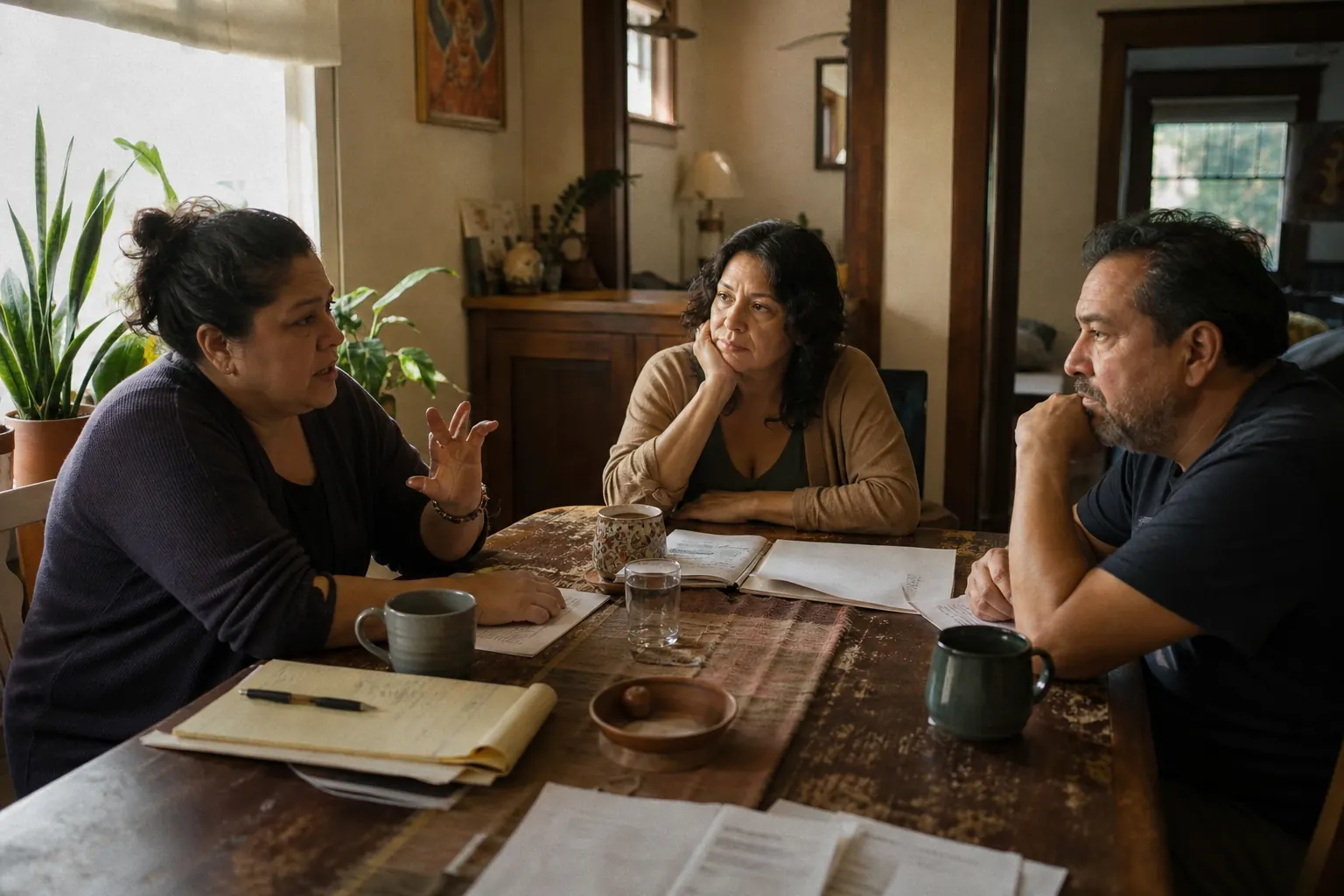


What sibling therapy is
Sibling therapy is therapy for the relationship between adult brothers and sisters. Two or more of you meet with me together, and the relationship between you is what we work on. Nobody is there to be fixed.
Siblings are often the longest relationship we ever have. You were there for each other’s first memories, and you’ll likely be there when your parents are gone. That history is what makes it so hard. You know exactly where each other’s buttons are, because you were there when they were installed.
Most adult siblings who reach out aren’t in open warfare. They’re stuck. Every phone call about Mom’s care ends with someone hanging up. One of you still feels like the little sister nobody takes seriously. Sibling therapy gives you a place to talk about it with someone who isn’t part of the family and isn’t on anyone’s side.
Everyone in the room is 18 or older. I don’t see children or teenagers, so this page is about adult siblings only.
Signs sibling therapy might help
- You fall back into childhood roles the minute you’re together: the responsible one, the baby, the one who always gets blamed.
- An old rivalry still runs underneath the conversation, even about small things.
- Caring for an aging or ill parent has turned into an argument about who does more.
- An inheritance, an estate or a family business has become a fight about fairness and love.
- You’ve drifted apart and don’t know how to close the distance.
- You haven’t spoken in months or years, and one of you wants to try.
- Your parents always carried messages between you, and now that they can’t, you don’t know how to talk directly.
You don’t need a crisis to start. Many siblings come in because they love each other and dread every holiday.
What adult siblings bring to therapy
Old roles and rivalry
Families hand out roles early. One child becomes the achiever, another the peacemaker, another the one who causes trouble. Those roles made sense once. Decades later they can still decide who gets listened to, who apologizes and who gets the benefit of the doubt. Rivalry often isn’t about the thing you’re arguing over. It’s about an older question: did Mom and Dad love you more, and do you see me as I am now? We name the roles out loud, and that alone often loosens them.
Caring for aging parents
This is one of the most common reasons siblings call me. One of you lives close and does the daily caregiving. Another lives far away and sends money, or advice, or nothing. Decisions about memory care, medical treatment or selling the family home stir up every old resentment at once. Sessions give you a place to divide the work and make decisions together before a crisis forces them.
Inheritance, estates and the family business
Money in families is rarely just money. A will, a house or a share of the family business can feel like a final verdict on who mattered. I don’t give legal or financial advice. What I can do is help you talk about what the money means to each of you, so the practical decisions don’t destroy the relationship.
Distance or estrangement
Sometimes siblings drift slowly, through moves, marriages and busy lives. Sometimes there was a break: a wedding nobody was invited to, a fight at a funeral, a choice of sides in a parent’s divorce. If you’ve stopped speaking altogether, family estrangement therapy goes deeper into how repair can start, and what to do when it isn’t safe or wanted.
Reconnection
Some siblings aren’t fighting at all. They just realize, often after a parent’s death or a health scare, that they barely know each other as adults. Sibling therapy can be a structured way to start again: to tell each other what childhood was actually like from where each of you stood, and to decide what kind of relationship you want now.
How I work with siblings
Most siblings already know what they fight about. What’s harder to see is why the same thing keeps happening. When your brother uses that tone, your nervous system reacts before you have time to think. You go quiet, or sharp, or you change the subject. He reacts to that. Within a minute, you’re both twelve.
So I work with what happens in the room, while it’s happening. We slow the conversation down, name what each of you is feeling and protecting, and try something different together. I draw on several approaches and use what fits your family:
- PACT, developed by Stan Tatkin for couples, explains how stress and old attachment patterns play out between people in real time. I use those ideas with siblings.
- Imago, from Harville Hendrix and Helen LaKelly Hunt, uses structured dialogue so each person actually hears the other before responding.
- Attachment-based work looks at how early relationships shape the way we reach for, or pull away from, the people closest to us.
- Interpersonal neurobiology explains how relationships shape the brain and nervous system, and how new experiences together can change old reactions.
- Gottman Method ideas from John and Julie Gottman give practical tools, like starting a hard conversation gently and repairing when it goes wrong.
- Emotionally Focused Therapy (EFT), developed by Sue Johnson, helps people see the cycle they’re caught in and the needs underneath it.
I also bring in family systems ideas, like the way two people in tension often pull a third person in to carry messages. Between siblings, that third person is often a parent. Sibling work is part of my wider family therapy practice.
Nobody is the problem. The pattern is.
How sessions work with two or more siblings
Sibling therapy can be two of you, or three or four. More people in the room means I keep the structure clear. Sometimes I meet with each sibling on their own before joint sessions start. That gives everyone a chance to say what they’re hoping for, and what they’re afraid of, without an audience.
In joint sessions, everyone gets a turn to be heard. I won’t let the oldest or the loudest do all the talking, and I won’t decide who was right about something that happened in 1994. Siblings often remember the same childhood very differently. Both memories can be true, and the goal is understanding, not a ruling.
I never contact a sibling without your consent. If you’re the one reaching out, you decide who is invited and when, and we can talk through how to ask them. If a parent wants to join later, that’s possible too, and therapy for parents and adult children explains how that work looks.
What to expect
It starts with a free 20-minute video consultation. One sibling can book it. You tell me a little about what’s going on, ask anything you like, and we see whether I’m a good fit. There’s no pressure to book.
A first joint session can be 90 minutes, which gives each of you time to speak without rushing. We’ll talk about what brought you in, what each of you wants to change, and start to map the pattern you keep landing in. Between sessions, you’ll usually have something small to try: a different way to start the call about Dad’s appointments, or a pause before replying in the group chat.
How much sibling therapy costs
- 60-minute session: $250
- 90-minute session: $325
- 20-minute video consultation: free
Fees are per session, not per person, however many siblings attend, so many families split the cost. I don’t bill insurance directly. For these sessions I can give you a superbill to submit to your insurer for possible out-of-network reimbursement. It’s worth calling your plan first to ask what they cover for family therapy.
In person in Highland Park, or online across California
My office is at 5317 North Figueroa Street in Highland Park. Siblings come from across Northeast LA and nearby, including Eagle Rock, Mount Washington, Glassell Park, Silver Lake, Echo Park, Pasadena and Glendale.
I also see siblings online anywhere in California, which helps when one of you is in Los Angeles and another is in Sacramento or San Diego. Some siblings mix the two, meeting in person when everyone is in town. When you’re ready, book a free consultation.