
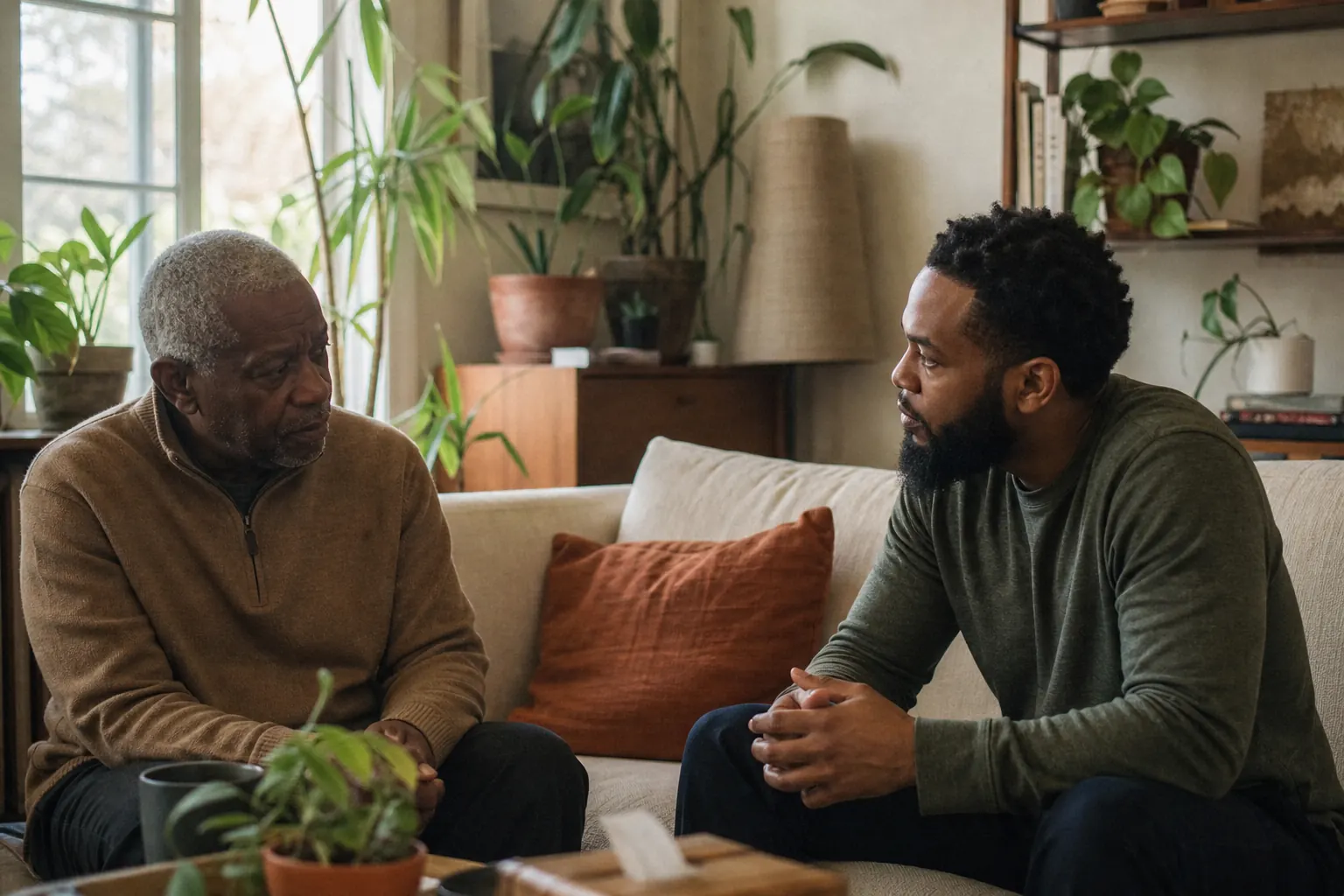


When someone in your family has stopped speaking to you, or you to them
Family estrangement is one of the loneliest kinds of pain, partly because so few people talk about it. Holidays come around and someone asks how your son is doing, or whether you’ll see your sister this year, and you don’t know what to say. Some people are the ones who stepped away and still carry guilt or grief. Others are the ones left behind, replaying the last conversation and checking their phone for a message that doesn’t come.
Estrangement rarely comes from one bad day. More often it builds over years: hurts that were never acknowledged, a pattern that felt impossible to change, a boundary that was crossed again and again. Sometimes there was a clear breaking point. Sometimes contact just faded until it stopped.
Family estrangement therapy is a place to make sense of what happened and decide, with support, what you want to do next. That might mean trying to reconnect. It might mean learning to live with distance in a way that hurts less.
Who I work with
Estranged adult children and parents
This is the most common kind of estrangement I see. A parent who feels cut off and doesn’t fully understand why. An adult child who needed distance to feel like their own person, or to protect themselves. Both are usually hurting, and both usually have a story the other hasn’t fully heard. My page on therapy for parents and adult children covers the wider work of this relationship.
Mothers and daughters
The mother-daughter bond carries so much expectation that a rupture can feel like losing part of yourself. See therapy for parents and adult children for more on how I work with this pair.
Adult siblings
Sibling estrangement often follows a parent’s illness or death, a fight over care or inheritance, or old childhood roles that never got revisited. You may share decades of history and still feel like strangers. Sibling therapy goes deeper on this.
Other family members
Grandparents, in-laws, cousins who were raised like siblings, chosen family. If the relationship matters to you, it’s worth working on, whatever the label.
Reconciliation sessions, or support on your own
There are two main ways I do this work, and many people move between them.
Individual support while you’re estranged
Most people start here, often because the other person isn’t ready or willing to come. In individual therapy we look at what happened from your side, the grief and anger you’re carrying, the guilt that can come with either leaving or being left, and what you actually want. If you’re the parent, we might work on understanding your child’s perspective without abandoning your own. If you’re the one who stepped back, we might work on holding your boundary without being consumed by the fallout. Either way, you don’t need the other person in the room for this to help.
Joint reconciliation sessions
When both people are willing, we can meet together. These sessions are carefully paced. The goal isn’t to settle who was right about the past. It’s to help each person say what they need to say, be heard, and find out whether a different kind of relationship is possible now. Joint sessions work best when each person has done some thinking on their own first, so sometimes I’ll suggest one or two individual sessions with each of you beforehand.
Reconnection isn’t always the goal, or safe
I want to be honest about this. Some estrangements protect people from real harm: abuse, ongoing cruelty, addiction that isn’t being addressed, or a family member who still won’t respect basic limits. In those situations, I won’t push you toward contact, and I won’t treat distance as a failure.
Healing is possible with or without reconciliation. For some people the work is grieving the relationship they hoped for, building a life that doesn’t revolve around the absence, and making peace with a decision they’ve already made. For others it’s figuring out whether limited contact, like a holiday card or a short visit with clear limits, feels right. I’ll help you think it through, and the decision stays yours.
If you’re ever in danger or thinking about harming yourself, call or text 988 to reach the Suicide and Crisis Lifeline, any time.
What a first joint session can look like
A first session with an estranged family member can feel enormous. Here’s roughly how I approach it, so you know what you’re walking into.
- Before: I usually meet or speak with each person separately first. I ask what you hope for, what you’re afraid of, and what would make it too much. I never contact a family member on your behalf without your agreement, and I don’t pressure anyone to attend.
- Agreements: We start by agreeing on how the session will go. Each person speaks without being interrupted. Either person can ask for a pause. Nobody has to resolve everything today.
- Listening first: Each of you gets time to say what this estrangement has been like for you. I help keep it to your own experience rather than a case against the other person.
- Slowing it down: When old defenses kick in, and they usually do, I slow things down and help each of you hear what’s underneath the reaction.
- A small next step: We end by deciding together what, if anything, happens next. That might be another session, a phone call, or simply time to think.
I often suggest 90 minutes for a first joint session, so there’s time for both people without rushing the ending.
Boundaries that hold
Whether you reconnect or not, boundaries tend to be at the center of this work. A boundary isn’t a punishment. It’s a clear statement of what you will and won’t do so the relationship can be survivable for you. We work on figuring out what your limits actually are, saying them plainly, and following through when they’re tested. If you’re on the receiving end of a boundary, we work on respecting it without taking it as the final word on your worth as a parent, child or sibling. Often a respected boundary is the thing that makes reconnection possible later.
How I work
I draw on attachment-based work, Emotionally Focused Therapy (developed by Sue Johnson), Imago dialogue (from Harville Hendrix and Helen LaKelly Hunt) and interpersonal neurobiology. In plain terms: I pay attention to the protective patterns each person learned in the family, how those patterns collide, and how a conversation in the room can be different from the ones that went wrong at home. I don’t take sides. Nobody is the problem; the pattern is. You can read more about the broader approach on my relationship therapy page.
Cost, and where we meet
- 60-minute session: $250
- 90-minute session: $325
- Free 20-minute video consultation
Joint session fees are per session, not per person. I don’t bill insurance directly, but I can provide a superbill for possible out-of-network reimbursement.
My office is at 5317 North Figueroa Street in Highland Park, a short drive from Eagle Rock, Mount Washington, Glassell Park, Silver Lake, Echo Park, Pasadena and Glendale. Some families prefer to meet in person on neutral ground, away from anyone’s home.
Estranged family members often live far apart, so I also see clients online anywhere in California. If your father lives in Sacramento and you live in Highland Park, you can each join from your own space. Some people find a screen makes a first conversation feel more manageable. If you’d like to talk about where you are and what might help, book a free consultation.